
Buying Guides
How to Choose a Vibrator 8 Specs That Actually Matter
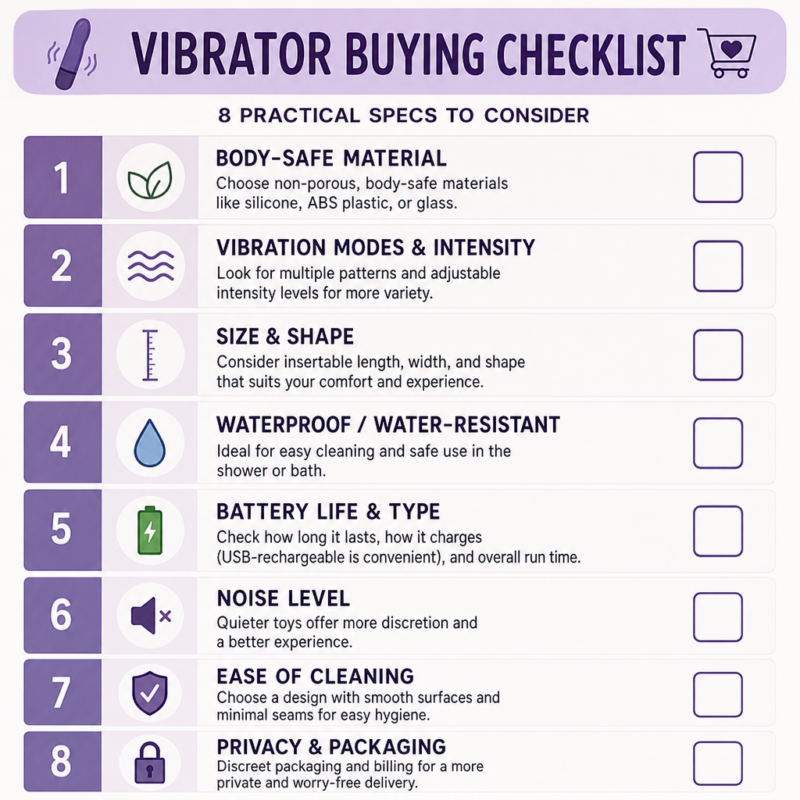
Choosing a vibrator is easier when you stop shopping by hype and start comparing the specs that affect comfort, safety, sensation, and everyday use. This guide explains the eight details that actually matter before you buy vibrator products online or in a store, from motor feel and material to shape, controls, charging, waterproofing, noise, and care. Use it as a practical vibrator shopping checklist whether you are buying your first toy, replacing one that never quite worked for you, or trying to understand vibrator reviews with more confidence.
What should you look for first when choosing a vibrator?
Start with your intended use, the material, and the type of stimulation you want. A vibrator that looks popular in a list of “best vibrators” is not automatically the right fit for your body, your sensitivity, or your routine. The smartest approach is to choose a category first, then compare the specs that influence how it feels, how easy it is to use, and how simple it is to clean.
A good guide to buying a vibrator should not push one universal “best” option. Some people want broad external pressure, some want targeted pinpoint vibration, some want an insertable toy, and others want a wearable, couples-friendly, or travel-friendly design. The right choice is the one that matches your comfort level, anatomy, privacy needs, mobility, and maintenance habits.
Here is the quick version before we go deeper:
- Decide where and how you want stimulation: external, internal, blended, wearable, or hands-free.
- Choose body-safe materials: nonporous materials are easier to clean and better for long-term use.
- Pay attention to motor quality: deeper, rumbly vibrations often feel different from buzzy surface-level vibration.
- Check size and shape honestly: bigger is not always better; ergonomics and control matter more.
- Read vibrator reviews for patterns: look for repeated comments about noise, battery life, intensity, and durability.
Plan for care: cleaning, storage, charging, and lubricant compatibility all affect whether you will actually enjoy using it.
Spec 1: Vibrator type and stimulation style
The first spec is not a number on a product page. It is the category of vibrator and the type of sensation it is designed to provide. This matters because vibrator types vary widely in shape, intensity, contact area, and how much control you have during use.
External vibrators
External vibrators are designed for stimulation outside the body. They include bullets, wands, palm vibrators, clitoral suction-style toys, finger vibrators, and compact massagers. They are often a comfortable starting point because they do not require insertion and can be used with more flexibility.
A bullet vibrator usually offers targeted stimulation in a small size. A wand typically provides broader, stronger vibration across a larger surface. A palm vibrator sits between those two categories, often offering more surface area than a bullet while still being easier to hold than a large wand. If you are unsure what you like, external toys are often easier to experiment with because you can adjust angle, pressure, and placement quickly.
Internal vibrators
Internal vibrators are designed for insertion and may be straight, curved, slim, textured, or shaped for specific pressure points. The most important detail is not just length, but usable insertable length, width, firmness, and curve. A toy can look manageable in photos but feel very different in the body if it is too rigid, too wide, or difficult to control.
If you are new to internal vibration, a slimmer, smoother design can feel less intimidating. If you already know you enjoy internal pressure, a curved shaft or firmer material may matter more. Always check that an insertable vibrator has a safe base, handle, or shape appropriate to its intended use.
Dual-stimulation vibrators
Dual-stimulation vibrators, sometimes called rabbit-style toys, are made to provide internal and external stimulation at the same time. They can be satisfying for people whose bodies align well with the shape, but fit is very personal. The external arm may not land where you expect, and the internal curve may or may not match your anatomy.
When reading vibrator reviews for this category, look for comments about flexibility, adjustability, and whether the external arm maintains contact. A dual-stimulation toy can be excellent when it fits well, but it is less universally adaptable than separate internal and external toys.
Wearable and couples vibrators
Wearable vibrators are designed to stay in place during solo use, partnered intimacy, or movement. Some are app-controlled, remote-controlled, or shaped to be worn externally or internally. These can be useful if you want hands-free stimulation, but they require closer attention to fit, noise, connectivity, and battery performance.
For couples use, comfort for both partners matters. A toy may be marketed as couples-friendly, but that does not mean it suits every position, body type, or preference. Look for flexible materials, slim profiles, intuitive controls, and reviews that mention whether the toy stays comfortably in place.
Spec 2: Material and body safety
Material is one of the most important parts of any vibrator buying guide because it affects comfort, cleaning, durability, and lubricant compatibility. The safest broad rule is to choose nonporous, body-safe materials from reputable sellers and avoid products with vague material descriptions. If a listing does not clearly state what the toy is made from, treat that as a warning sign.
Common body-safe materials include silicone, ABS plastic, stainless steel, and borosilicate glass. Silicone is popular because it can feel soft, flexible, and skin-like while remaining nonporous when properly made. Hard plastic is often used for bullets and compact vibrators because it transmits vibration efficiently. Stainless steel and glass are firm, smooth, and easy to clean, though they feel very different from softer toys.
The keyword “guide to buying organic vibrator” appears in some searches, but “organic” can be misleading for a powered sex toy. Vibrators contain electronics, motors, batteries, and manufactured materials, so it is more useful to look for body-safe, nonporous, phthalate-free, and clearly labeled materials rather than relying on the word organic. If a brand uses natural or eco-conscious language, still check the actual material, charging method, packaging claims, and warranty information.
Materials to approach carefully
Some soft materials are porous, meaning they can hold onto bacteria, odors, or residue more easily than nonporous materials. Porous toys can be harder to clean thoroughly and may degrade faster. If you use a porous product, consider using a condom over it, avoid sharing it, and inspect it frequently for changes in texture, smell, or surface condition.
Be cautious with listings that use vague terms like “jelly,” “realistic feel,” “skin-like blend,” or “premium material” without naming the actual material. Those words describe marketing impressions, not safety information. A trustworthy product page should make material details easy to find.
Lubricant compatibility
Lubricant can make vibrator use more comfortable, especially for internal toys, firmer materials, or longer sessions. Water-based lubricant is widely compatible with most vibrator materials and is a safe default. Silicone-based lubricant can last longer, but it may not be compatible with some silicone toys because it can affect the surface over time.
Before using silicone lubricant with a silicone vibrator, check the manufacturer’s instructions. If you cannot find clear guidance, choose water-based lubricant. This is one of the simplest vibrator tips, but it prevents a common mistake that can shorten the life of a toy.
Spec 3: Motor feel, intensity, and vibration pattern
Motor quality shapes the entire experience. Two vibrators can have the same number of speeds and still feel completely different because vibration is not only about strength. It is also about depth, steadiness, range, and how the sensation travels through the toy.
People often describe vibration as either “buzzy” or “rumbly.” Buzzy vibration tends to feel more surface-level and high-frequency. Rumbly vibration feels deeper and may spread more through tissue. Neither is automatically better, but many shoppers find that understanding this difference makes vibrator reviews much more useful.
Why intensity levels are not enough
A product listing may say a vibrator has multiple speeds, but the number of speeds does not tell you whether the lowest level is gentle enough or the highest level is strong enough. A toy with three well-spaced intensities can be more useful than one with many settings that feel nearly identical. The range matters more than the count.
If you are sensitive, look for reviews that mention a soft starting level, gradual escalation, or good low settings. If you prefer strong stimulation, look for repeated comments about power, depth, and whether the motor slows under pressure. If you are unsure, choose a toy with a broad intensity range rather than one marketed only as ultra-powerful.
Patterns versus steady vibration
Many vibrators include pulse, wave, escalation, or rhythm patterns. Some people love patterns because they create variety; others ignore them completely and use only steady vibration. Patterns are a bonus, not a core reason to buy unless you already know you enjoy them.
When comparing vibrator recommendations, prioritize the quality of the steady modes first. A toy with excellent steady vibration and a few usable patterns is usually more practical than a toy with many novelty patterns and weak basic settings. Controls also matter here: if it is hard to return to your favorite setting, you may not enjoy the extra options.
Spec 4: Size, shape, and ergonomics
Size affects comfort, but shape determines usability. A vibrator should be easy to hold, position, control, and clean. The most attractive design in a photo can become frustrating if the handle is slippery, the buttons are awkward, or the angle does not work for your body.
For external vibrators, consider the contact area. A small tip offers precision, while a broader head spreads sensation. A wand head may feel powerful but less targeted. A curved palm toy may be easier to press against the body without hand strain. If you have limited grip strength, wrist pain, mobility concerns, or sensory sensitivities, ergonomic shape becomes even more important.
For internal vibrators, check length, girth, curve, firmness, and base design. Longer does not always mean more pleasurable, and wider does not always mean more advanced. Comfort depends on arousal, lubricant, anatomy, and personal preference. If you are newer to insertable toys, start with moderate dimensions and a smooth shape rather than jumping to something large or heavily textured.
Shape details that affect real use
Small design choices can make a major difference:
- Button placement: Buttons should be reachable without twisting your hand awkwardly.
- Grip texture: A smooth toy may be beautiful but slippery with lubricant.
- Flexible necks or arms: Flexibility can improve fit, but too much flexibility may reduce pressure.
- Flat bases: A base can make storage easier and may be essential for certain insertable uses.
- Tapered tips: A tapered shape can make initial contact or insertion more comfortable.
- Weight balance: A heavy motor in the wrong place can tire your hand during longer use.
These details rarely get the same attention as color or packaging, but they often decide whether a toy becomes a favorite or stays in a drawer.
How do you match a vibrator to your experience level?
Match the vibrator to what you already know about your preferences, then leave room to explore. Beginners often do best with versatile, moderate-intensity toys that are easy to clean and simple to control, while experienced users may want more specialized shapes, stronger motors, or advanced features. The goal is not to buy the most complicated option; it is to buy the one that removes friction from use.
If you are buying your first vibrator
A first vibrator should be approachable, easy to operate, and not overly specialized. A compact external vibrator, palm vibrator, or medium-powered wand can be a practical starting point. These styles let you experiment with pressure, placement, and intensity without committing to a very specific internal shape.
Look for simple controls, body-safe material, a rechargeable battery if possible, and a low setting that is genuinely gentle. Avoid choosing solely based on the strongest motor or the most dramatic product description. The best first vibrator is often the one that feels unintimidating enough to use regularly.
If you already know what you like
If you have used vibrators before, your next purchase should solve a specific problem or expand a specific pleasure preference. Maybe your current toy is too loud, too weak, too hard to clean, or difficult to hold. Maybe you want more pressure, less pinpoint sensation, a travel lock, or a waterproof design for easier cleaning.
Write down what worked and what did not work with your past toys. This turns vague vibrator shopping into a clear comparison. For example, if you liked the strength of a wand but not the size, look for a compact wand or palm massager with a rumbly motor. If you liked a bullet’s precision but found it too buzzy, search reviews for deeper vibration in a similarly small shape.
If you are shopping with a partner
Partnered shopping works best when both people discuss comfort, boundaries, and intended use before choosing a toy. A vibrator is not automatically a performance tool or a replacement for intimacy; it can simply add sensation, novelty, or accessibility. The healthiest choice is one that supports communication rather than pressure.
Consider who will hold it, how it will be controlled, whether either person needs quieter operation, and whether the shape suits the activities you have in mind. If the toy is insertable or wearable, fit and comfort matter more than novelty features. Choose something both partners feel good about cleaning, storing, and using.
Spec 5: Controls, modes, and ease of use
Controls are easy to overlook until they interrupt the moment. A vibrator can have excellent power and material but still be annoying if the buttons are hard to press, the modes cycle in one direction, or the toy is difficult to turn off quickly. Good controls make the experience feel intuitive.
Look for separate buttons for power and intensity when possible. One-button toys can be simple, but they may force you to click through every setting to return to a lower speed or turn the toy off. Multi-button controls can be better if the layout is clear and easy to operate by touch.
Control features worth checking
A useful control setup may include:
- A clear power button: You should not have to guess how to start or stop the toy.
- Separate intensity adjustment: Moving up and down is easier than cycling through every mode.
- Mode memory: Some toys restart on the last setting used, which may or may not be what you prefer.
- Travel lock: Helpful if you plan to pack the toy in luggage or a shared drawer.
- Remote or app control: Useful for distance, partnered play, or accessibility, but not necessary for everyone.
- Tactile buttons: Raised or textured buttons are easier to find without looking.
If you are reading vibrator reviews, search for phrases like “easy to use,” “buttons are confusing,” “hard to turn off,” or “accidentally changes modes.” These comments reveal everyday usability better than a feature list.
App-controlled toys
App-controlled vibrators can offer long-distance control, custom patterns, and discreet operation. They can also introduce extra steps: pairing, charging, updates, privacy settings, and occasional connectivity issues. If you enjoy tech features, this may be a benefit. If you want simple, reliable use, a physical remote or onboard controls may be better.
Before choosing an app-controlled vibrator, check whether the toy can still function without the app. Also consider whether you are comfortable with any account setup or permissions required. Convenience should not come at the cost of comfort or privacy.
Spec 6: Power source, charging, and battery life
A vibrator’s power system affects convenience, travel, storage, and long-term value. Rechargeable vibrators are common and reduce the need for disposable batteries, but charging style varies. Some use magnetic charging pins, some use charging docks, and others use covered ports.
Battery-operated toys can still be useful, especially for lower-cost entry-level options or travel backups. However, they may lose power as batteries drain, and replacement batteries add ongoing cost. Rechargeable toys often provide steadier performance, but only if you remember to charge them.
Charging details to compare
When you compare products, look beyond “USB rechargeable” and check the practical details:
- Charging connector: Magnetic chargers are convenient but can detach if bumped.
- Charging time: A long charge time may be fine if you plan ahead, but frustrating if you do not.
- Runtime: Compare expected runtime at typical use, not only at the lowest setting.
- Indicator lights: Clear lights help you know when the toy is charging or fully charged.
- Storage while charged: Check care instructions if you store toys for long periods.
- Cable replaceability: A proprietary charger can be inconvenient if lost.
If you travel often, a travel lock and reliable charging method may be more important than extra vibration patterns. If you use a toy frequently, battery consistency and easy charging become core specs, not small conveniences.
Spec 7: Waterproofing, cleaning, and maintenance
Cleaning is part of the product experience. A vibrator that is difficult to clean is less likely to be used confidently, especially if it has seams, textured surfaces, exposed ports, or complex shapes. Waterproofing can make cleaning easier, but terms like waterproof, water-resistant, and splashproof are not always interchangeable.
A fully waterproof vibrator is generally easier to rinse according to the manufacturer’s directions. A water-resistant toy may tolerate splashes but should not be submerged. If the product page is unclear, do not assume it is safe for bath or shower use.
Cleaning basics
Always follow the manufacturer’s care instructions, but a simple routine often includes washing before and after use with mild soap and warm water or a compatible toy cleaner. Dry the toy completely before storage. Store it away from dust, lint, direct sunlight, and materials that may react with its surface.
For textured toys, pay extra attention to grooves and seams. For toys with charging contacts, make sure they are dry before charging. For shared use, use condoms or barriers and clean carefully between users or between different types of use.
Storage habits that protect your purchase
Good storage keeps the material clean and helps prevent surface damage. Many toys come with a pouch, but if yours does not, a clean fabric bag or dedicated storage container can help. Avoid tossing multiple silicone toys together unless the manufacturer says it is safe, because some materials can interact over time.
This is where a practical guide to buying a vibrator overlaps with long-term care. The easiest toy to love is not only the one that feels good; it is the one that fits your cleaning and storage habits.
How should you read vibrator reviews without getting overwhelmed?
Read vibrator reviews by looking for repeated patterns, not isolated opinions. One person’s perfect toy may be too strong, too weak, too large, or too loud for someone else, so the most useful reviews explain preferences and context. Focus on comments about motor feel, comfort, noise, controls, material, durability, and whether the toy performed as described.
What to trust in reviews
The best reviews usually include specific details. A review that says “amazing” is less useful than one explaining that the toy has a gentle first setting, a broad head, quiet operation under blankets, or buttons that are hard to press with lubricant. Specificity helps you compare the reviewer’s needs with your own.
Look for repeated mentions across multiple reviews. If many shoppers say the toy is louder than expected, difficult to clean, or smaller than photos suggest, take that seriously. If one person dislikes the color or packaging, that may not matter to you.
Red flags in product listings
Be cautious if a listing relies on vague claims without specs. Words like “premium,” “luxury,” “powerful,” or “body-safe” should be backed by material details, measurements, waterproof rating language, charging information, and clear care instructions. A product does not need to be expensive to be good, but it should be transparent.
Red flags include:
- No clear material listed
- No dimensions or only vague size descriptions
- No cleaning instructions
- No explanation of charging or battery type
- Overly exaggerated pleasure claims
- Poor or inconsistent reviews mentioning defects
- Photos that do not show scale, controls, or shape clearly
When in doubt, choose clarity over mystery. A straightforward product page with honest specs is more useful than a dramatic listing that hides the basics.
Spec 8: Noise level, discretion, and travel readiness
Noise is a practical spec, especially if you share walls, live with others, travel often, or simply prefer discretion. Most vibrators make some sound because they contain motors, but the type of sound varies. A deep hum may be less noticeable through a door than a high-pitched buzz, even if both feel similarly strong.
Product pages may describe a toy as quiet, whisper-quiet, or discreet, but these terms are subjective. Reviews are often more helpful because users may describe whether the toy can be heard under blankets, through a closed door, or in a shared home. Remember that stronger settings are usually louder than lower settings.
Travel readiness includes more than sound. A travel lock prevents accidental activation in a bag. A storage pouch keeps the toy clean. A compact shape is easier to pack. If you travel internationally, charging compatibility and cable type may also matter. If privacy is important, consider whether the packaging, app name, or charging cable feels discreet enough for your situation.
The eight-spec vibrator shopping checklist
Use this checklist before you buy vibrator products so you can compare options clearly instead of relying on guesswork. You do not need the most expensive toy or the longest feature list. You need the best fit for your body, preferences, and real-life routine.
| Spec | What to check | Why it matters |
|---|---|---|
| Vibrator type | External, internal, dual, wearable, wand, bullet, palm, remote-controlled | Determines the kind of stimulation and how flexible the toy is |
| Material | Silicone, ABS plastic, glass, stainless steel, or clearly named body-safe material | Affects cleaning, comfort, durability, and lubricant compatibility |
| Motor feel | Rumbly or buzzy, gentle or strong, range of intensities | Shapes the sensation more than speed count alone |
| Size and shape | Dimensions, curve, contact area, handle, weight, base | Influences comfort, control, and fit |
| Controls | Button layout, mode cycling, remote, app, travel lock | Determines how easy the toy is to use in the moment |
| Power source | Rechargeable or battery-operated, runtime, charger type | Affects convenience and long-term usability |
| Waterproofing and cleaning | Waterproof vs water-resistant, seams, care instructions | Makes maintenance easier and safer |
| Noise and discretion | Sound level, pitch, travel pouch, lock feature | Supports privacy at home and while traveling |
Keep this list nearby when comparing vibrator types or reading vibrator recommendations. It will help you separate meaningful features from marketing language.
Common buying mistakes and how to avoid them
Many disappointing purchases happen because shoppers focus on the wrong details. Color, packaging, and popularity are easy to notice, but they do not tell you whether a vibrator will suit your sensitivity, anatomy, or lifestyle. A better approach is to identify your must-haves before browsing.
Mistake 1: Buying the strongest option by default
Power can be great, but intensity without control can feel overwhelming. If a toy’s lowest setting is too strong, you may not use it often. Choose range over raw strength, especially if you are sensitive or new to vibrators.
Mistake 2: Ignoring dimensions
Photos can be misleading. Always check measurements, especially for internal toys, wands, and wearable designs. Compare dimensions with something familiar at home so the size feels real before you buy.
Mistake 3: Assuming all silicone is the same
Material quality and design still matter. A toy may be silicone-coated, partially silicone, or made with different firmness levels. Read the material description carefully and check care instructions.
Mistake 4: Overvaluing novelty features
App control, patterns, heating, suction-style technology, and remote features can be enjoyable, but they should support your needs. If the core shape, motor, and controls are not right, novelty features will not fix the experience.
Mistake 5: Skipping cleaning and storage details
A hard-to-clean toy can become a toy you avoid. Look at seams, textures, charging ports, and waterproofing before purchasing. The simpler the maintenance, the easier it is to use the vibrator confidently.
Matching common preferences to vibrator types
There is no single product that deserves the title of best vibrator for everyone. However, you can narrow your search by matching common preferences to categories.
If you want pinpoint external stimulation, consider a bullet or slim-tip vibrator. These are compact, precise, and easy to position, though some can feel buzzy depending on motor quality.
If you want broad external stimulation, consider a wand or palm vibrator. These spread sensation over a larger area and can be easier to use through fabric or with more pressure.
If you want internal fullness or pressure, look at internal vibrators with smooth shapes, clear dimensions, and body-safe materials. Curved designs may offer more targeted pressure, but fit is personal.
If you want internal and external stimulation together, dual-stimulation toys may be worth exploring. Pay close attention to flexibility and reviews about anatomical fit.
If you want hands-free or partnered use, consider wearable or remote-controlled vibrators. Prioritize comfort, quietness, battery reliability, and whether the toy stays in place.
If you want simple travel-friendly use, choose a compact rechargeable toy with a travel lock, storage pouch, and straightforward controls. Skip bulky shapes unless they are essential to your preference.
A practical step-by-step guide to buying a vibrator
A step-by-step process keeps you from getting lost in endless product pages. Use this approach whether you are browsing a boutique, reading a how to choose a vibrator buying guide, or comparing online listings.
- Choose the main use case. Decide whether you want external, internal, dual, wearable, partnered, or travel-friendly use.
- Set your comfort boundaries. Identify preferred size range, firmness, noise level, and whether insertion is part of the plan.
- Filter by body-safe materials. Remove listings with unclear or questionable material information.
- Compare motor descriptions. Look for reviews that mention rumbly, buzzy, gentle, strong, broad, or pinpoint sensation.
- Check controls and charging. Make sure the toy is easy to operate, recharge, and turn off.
- Review cleaning instructions. Confirm waterproofing, seams, and lubricant compatibility.
- Read a range of reviews. Prioritize detailed, balanced feedback over extreme praise or complaints.
- Choose the most usable option. The best choice is the one you will feel comfortable using, cleaning, storing, and reaching for again.
This process may feel slower at first, but it saves time and money by preventing impulse buys based on appearance alone.
Final vibrator tips before you buy
The best vibrator recommendations are the ones that help you understand yourself, not just a product. Before purchasing, think about what you want more of: stronger sensation, gentler stimulation, easier handling, quieter use, better fit, simpler cleaning, or more versatility. That answer will guide you better than any bestseller label.
If you are unsure, choose a versatile, body-safe vibrator with a comfortable shape, multiple usable intensities, simple controls, and clear care instructions. If you are experienced, shop for the specific upgrade your current toy is missing. And if a product page leaves you guessing about material, size, charging, or cleaning, keep looking.
A thoughtful vibrator purchase should feel informed, not intimidating. Use the eight specs in this guide, read reviews with context, and choose the toy that fits your body and your life—not just the one with the loudest marketing.
Related products
- Svakom Primo Wearable G-Spot & Anal Remote Controlled bullet vibrator — $64.90
- Tenga Iroha Lipstick vibrator — $24.99
- Svakom Mini Emma Flexible Ultra Soft Clitoris Double Wand Vibrator — $37.00
- Roomfun Forced Orgasm BDSM massage vibrator For Men — $68.99