
Sex Toy Guides
How to Use a Vibrator Safely: A Beginner’s Guide
Learning how to use a vibrator safely comes down to five habits, not a long rulebook: choose a body-safe toy that suits the body part you plan to use it on, use enough lubricant, clean it before and after use, use condoms when toys are shared or moved between body areas, and stop if anything hurts. Everything else — materials, storage, batteries, cleaning products — is detail layered on top of those five.
This guide covers the practical version for beginners, including the rules that actually prevent problems and the warning signs that mean it is time to stop and get medical advice.
The 30-second answer
Sex toys are safe when they are: made from a non-porous, body-safe material such as silicone, hard ABS plastic, stainless steel or glass; used with enough lubricant; cleaned with mild soap and warm water before and after use; covered with a fresh condom when shared or moved from one body area to another; and used only for the job they were designed for.
The main risks are mundane: friction and irritation, allergic reactions to materials or lubricants, bacteria left on a toy, sharing without a barrier, and improvised objects that break, scratch or get stuck. Preparation removes almost all of them.
Are sex toys safe to use?
Yes, for most people, when they are clean and used as intended. The clearest way to think about infection risk is sharing: if someone with an infection uses a toy, body fluids left on that toy can pass the infection to the next person who uses it. Sexual-health guidance is straightforward about the fix — wash toys with mild soap and water after use and before they touch another person, and put condoms on shared toys, changing the condom before the toy touches a different body (Planned Parenthood).
The other common issues are not infections at all: too much friction, a lubricant that stings, a rough seam, or a toy that was never meant for the body part it is being used on.
Start with a body-safe material and a simple shape
Beginners do best with uncomplicated toys from sellers who state the material clearly. Body-safe silicone, hard ABS plastic, stainless steel and borosilicate glass are all non-porous, which means they rinse clean instead of holding on to bacteria the way cheap jelly or TPR blends can.
Skip anything with cracks, a sticky or peeling surface, a strong chemical smell, sharp seams, exposed wiring or a material the listing will not name. Before first use, inspect the toy in good light and run clean fingers over the surface. If it vibrates, test every setting away from your body first so the intensity is not a surprise.
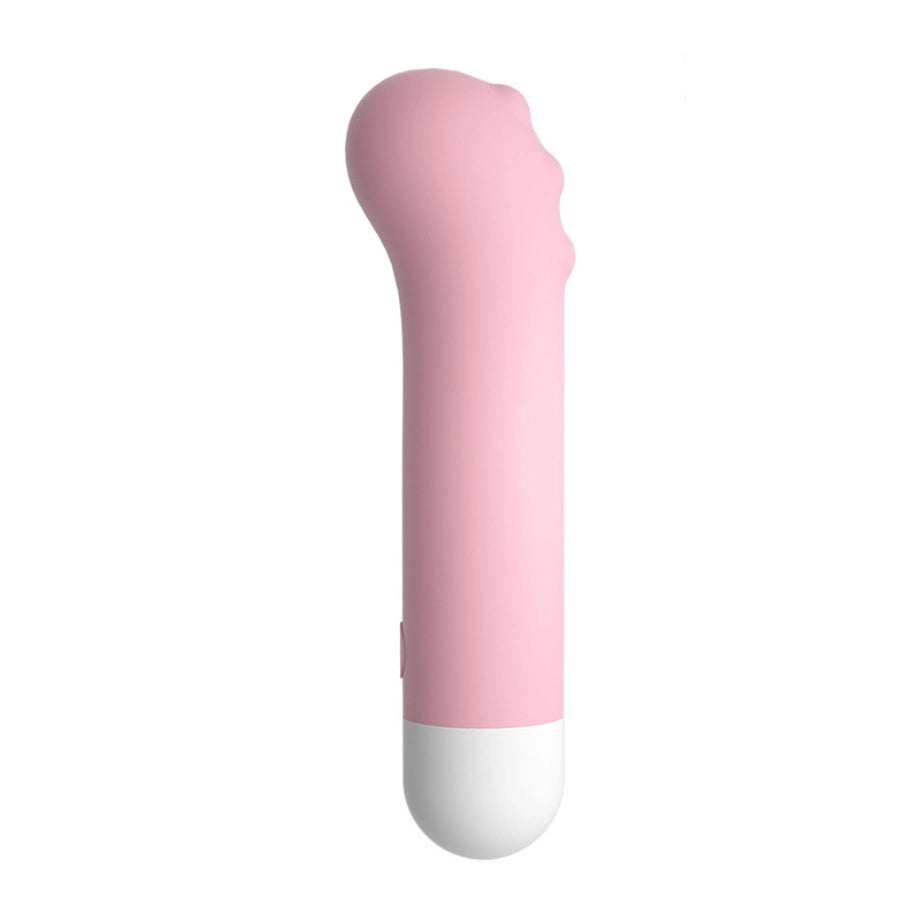
Two beginner-friendly shapes cover most first purchases: a small external vibrator such as a bullet vibrator, and something broader if direct pinpoint vibration feels too intense. Our vibrator collection is organised by shape so you can compare sizes before choosing.
Use more lubricant than you think you need
Lubricant is the cheapest safety measure there is. It reduces friction, which is the usual cause of soreness and micro-irritation, and it matters most with penetrative toys, longer sessions, condoms and anal play. Reapply when things start to feel dry instead of pushing through.
Water-based is the safe default
Water-based lubricant works with every toy material and every condom, which is why it is the default recommendation for beginners. Silicone-based lubricant lasts longer but can degrade silicone toys, so check the toy’s instructions before pairing them. Oil-based products should not be used with latex condoms because oil weakens latex — water-based or silicone-based is the safe pairing (Planned Parenthood).
Stop if lubricant stings or burns. Some formulas contain ingredients that irritate sensitive skin, and no formula is worth pushing through discomfort for.
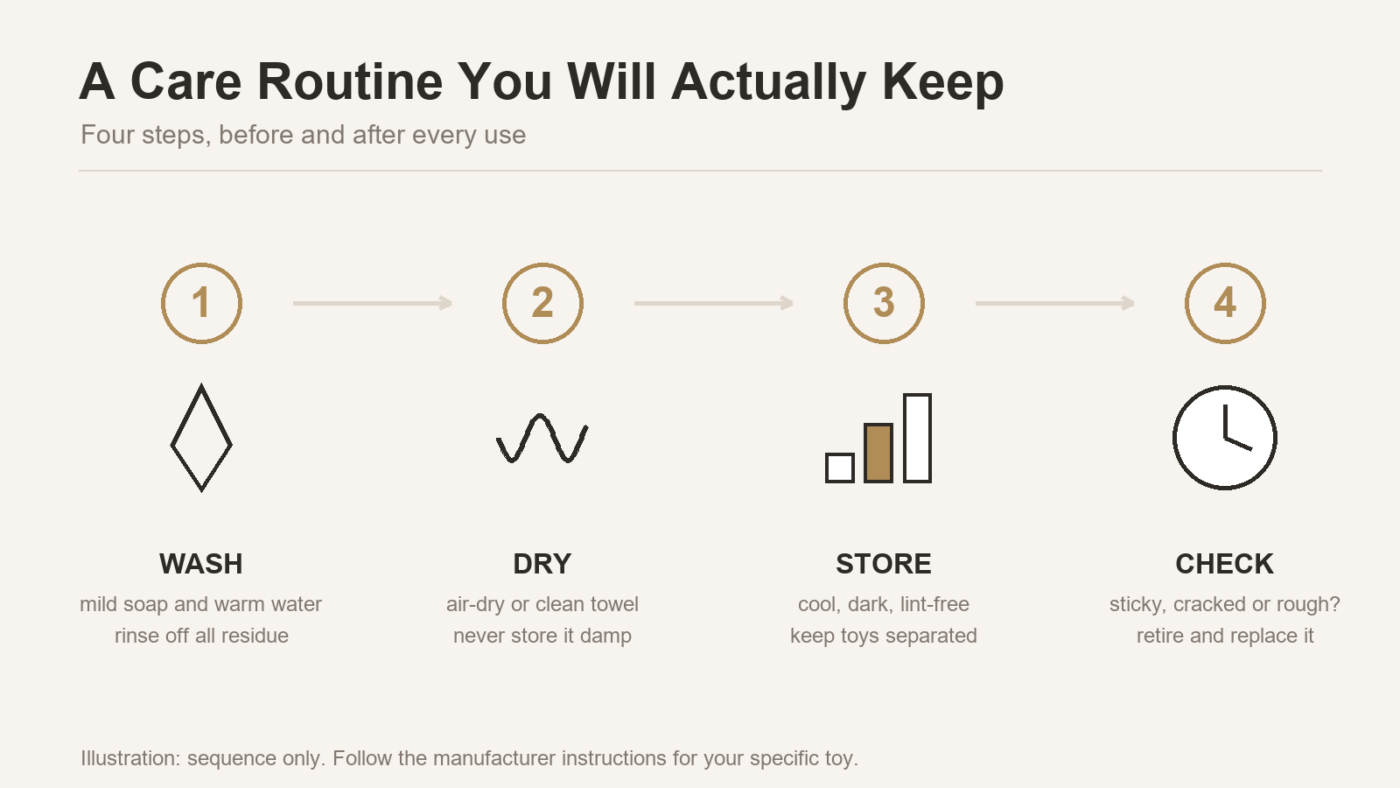
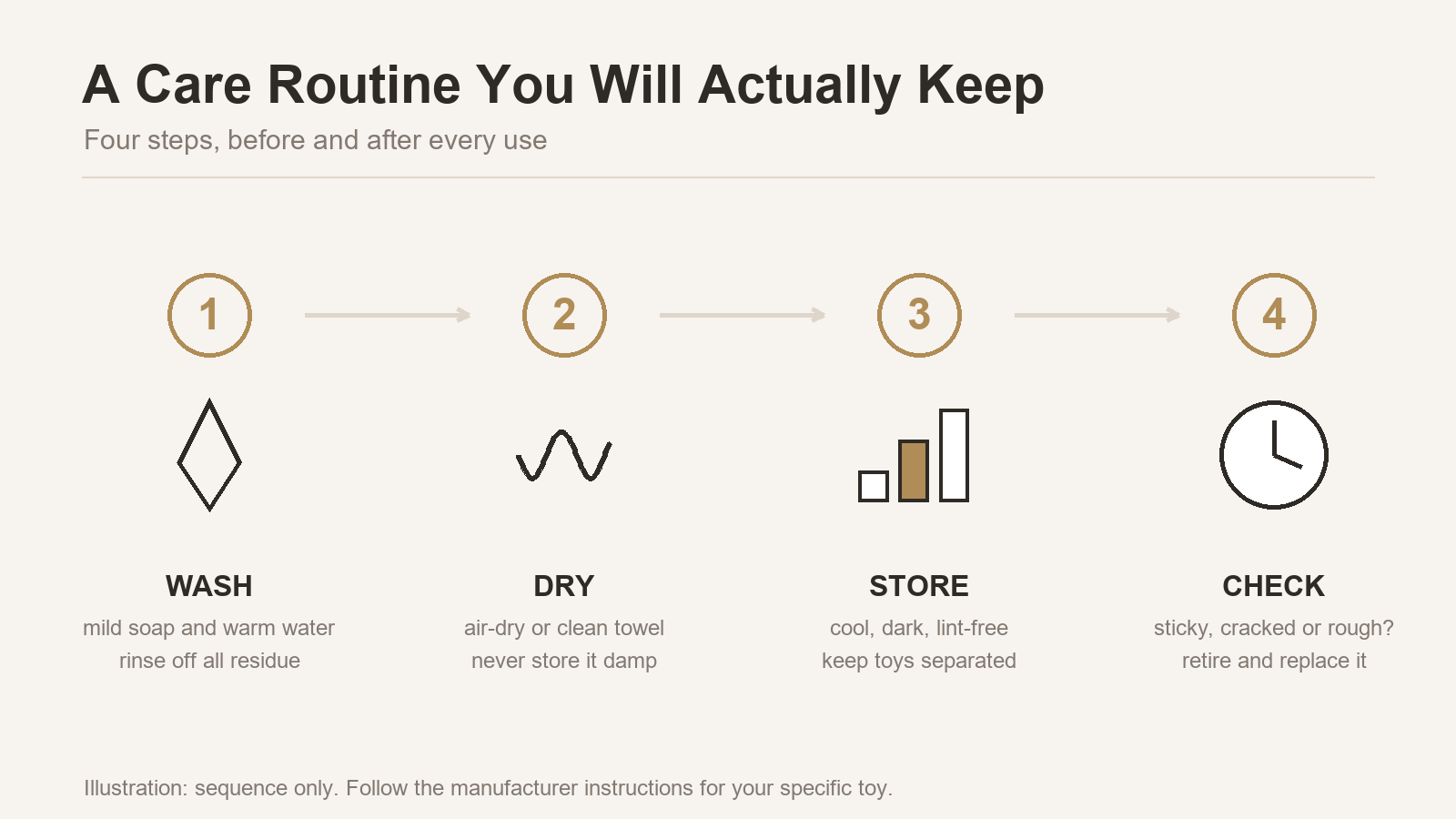
Clean before and after — with a routine you will keep
For most non-motorised, waterproof toys, mild soap and warm water are enough: rinse thoroughly so no soap residue stays behind, then dry the toy completely. Vibrators and anything with a motor need more care around seams, buttons and charging ports — many are splashproof rather than fully waterproof, so follow the maker’s instructions instead of assuming.
Pay attention to textured areas, ridges and suction openings where fluid collects. If a toy cannot be cleaned properly, cover it with a condom each time or replace it with something easier to clean.
Four questions that pick your first toy
If you are choosing a first vibrator, four questions narrow the field faster than any top-ten list.
- External, internal or both? External toys are the simplest starting point and the easiest to clean. Internal shapes and dual-stimulation toys do more, but they are a bigger first commitment.
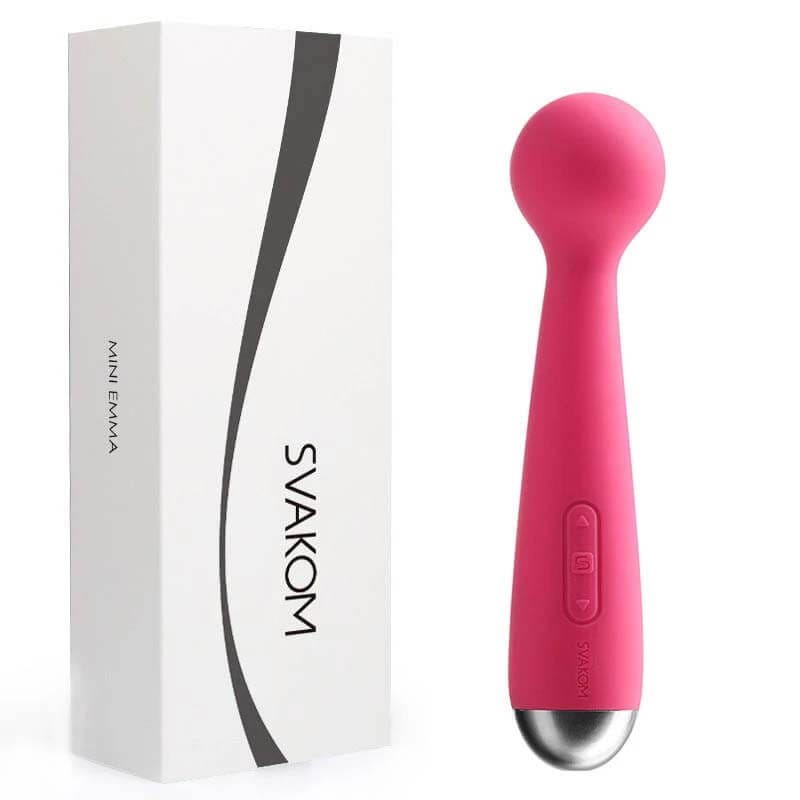
- Broad or pinpoint? A wide head spreads vibration over more area and is forgiving about placement; a small tip is precise but rewards accuracy. If you are unsure, a mini wand sits in the middle.
- Quiet enough for your home? Shared walls or roommates make noise a real specification, not a detail.
- Can you clean it properly? Non-porous, smooth and ideally waterproof. If you cannot picture yourself rinsing it in a minute, it will not get cleaned often enough.
Lubricant types, in one table
| Type | Works with | Watch out for |
|---|---|---|
| Water-based | Every toy material and every condom | Needs reapplying more often |
| Silicone-based | Condoms, and toys that are not silicone | Can degrade silicone toys; check the maker’s instructions |
| Hybrid | Most condoms and most toys | Still worth testing on a small area first |
| Oil-based | Polyurethane and nitrile condoms | Weakens latex condoms — avoid them with latex |
Whatever you choose, the practical rule is the same: stop if it stings or burns, and reapply rather than pushing through dryness.
Introducing a toy with a partner
Talking about toys before they appear in the bedroom usually works better than surprising someone with one. A short, low-pressure conversation covers most of it: what you are curious about, whether your partner wants to watch, hold or use it, and what you will do if either of you wants to stop.
Agree on a stop signal, keep the toy clean, and use a condom if the toy will touch more than one person or move between body areas. Consent that can be withdrawn without explanation is what makes experimentation feel safe enough to enjoy.
Condoms, sharing and switching body areas
Condoms turn a shared toy into a low-risk one, and they are also useful on porous toys or toys with complicated textures. They do not replace washing — they add a barrier on top of it. Use a new condom for each person and each body area, and never move a toy from the anus to the vagina without washing it or changing the condom first, because bacteria from the anus can cause vaginal infections.
If a partner has an active infection or unexplained symptoms, pause toy sharing until treatment and medical advice are complete.
Anal toys: the flared-base rule
One rule has no exceptions: anything inserted anally needs a wide flared base, a large handle, or a retrieval ring that stays outside the body. The rectum can pull objects inward, and a toy without a secure base can become difficult or impossible to remove without medical help. Both the anatomy and the advice are unambiguous — toys for anal use should be wider at the base, or have another way to pull them out (Planned Parenthood).
Anal play also needs more lubricant than vaginal play, because the anus does not self-lubricate. Start small, go slowly, and stop with sharp pain, bleeding or dizziness. Do not use numbing products to push through discomfort — pain is useful feedback. Purpose-built toys are designed around that rule; that is exactly what to look for in our butt plugs.
Why homemade and household objects are riskier
Improvised objects break, scratch, trap bacteria or lack a safe retrieval base, and they are usually made of materials that were never designed for internal use. Avoid glass bottles, candles, food, electric toothbrushes, markers, tools, or anything sharp, brittle, painted, scented or breakable. Nothing with exposed batteries, cords or detachable parts belongs near a body opening.
Purpose-built toys are not expensive by comparison — the LILO Bereron multi-frequency bullet vibrator and the Svakom Mini Emma double wand vibrator are both examples of simple, body-safe designs that cost less than a replacement emergency-room visit.
Beginner dos and don’ts
| Do | Don’t |
|---|---|
| Choose toys made for the body area you plan to use | Share a toy without cleaning it or changing the condom |
| Read the care instructions before first use | Use silicone lubricant on a silicone toy unless the maker says it is compatible |
| Wash hands and toys before and after use | Move a toy from anus to vagina without washing or changing the condom |
| Use water-based lubricant when you are unsure | Use damaged, sticky, cracked or unnamed-material toys |
| Store toys clean, dry and separated | Insert household objects that can break, scratch or get stuck |
| Stop immediately if something hurts | Ignore persistent pain, bleeding, burning or unusual symptoms |
Storage protects the toy and your body
Store toys only when they are completely dry, ideally in a breathable pouch, a dedicated case or a clean drawer, with toys kept apart so materials cannot react with each other. Remove batteries from anything you will not use for a while, keep chargers, remotes and manuals together, and keep everything away from extreme heat, direct sunlight and shared household spaces.
Retire a toy when the surface becomes sticky, cracked, discoloured or rough. A toy you cannot clean properly is no longer a body-safe toy — that is also the reason used items are excluded from our return policy for hygiene reasons, and why defective items are handled by replacement.
When to stop and get medical help
Stop and speak to a healthcare professional if you notice pain that does not settle with more lubricant and a slower pace, bleeding, swelling, numbness, a rash, burning when urinating, unusual discharge, sores, fever, or a toy that becomes stuck. Never keep digging for a stuck object with tools. Seek urgent care for rectal objects, significant bleeding or severe pain.
For order and product questions — what ships, how it is packed, how to reach support — our help and FAQs covers the store side of things.
Frequently asked questions
Are sex toys safe to use?
Yes, for most people, when the toy is made from a body-safe non-porous material, used with enough lubricant and cleaned properly. The main risks are friction and irritation, reactions to materials or lubricants, bacteria left on a shared toy, and improvised objects that break or get stuck.
How often should I clean a vibrator?
Before first use and after every session. Mild soap and warm water are enough for waterproof silicone; if the toy is not waterproof, keep water away from seams, buttons and charging ports. Dry it completely before storing it, because damp storage shortens the life of the material.
What lubricant should beginners use?
Water-based lubricant, because it works with every toy material and every condom. Silicone-based lubricant lasts longer but can degrade silicone toys, and oil-based products should not be used with latex condoms. Stop using any lubricant that stings or burns.
Can you share sex toys safely?
Yes, with two steps: wash the toy with mild soap and water before it touches another person, and put a fresh condom on it for each person and each body area. Condoms add a barrier but do not replace washing the toy.
Do all anal toys need a flared base?
Yes, without exception. Anything inserted anally needs a wide flared base, a large handle or a retrieval ring that stays outside the body, because the rectum can pull an object inward and a toy without a secure base may need medical removal.
When should I stop using a sex toy?
Stop if you notice pain that does not settle with more lubricant and a slower pace, bleeding, swelling, numbness, a rash, burning when urinating, unusual discharge, fever, or a toy that becomes stuck. Never try to remove a stuck object with tools — seek medical care.
Final answer
Safe use is mostly preparation: pick a body-safe toy built for the body part, use plenty of water-based lubricant, clean before and after, use condoms when sharing, and remember the flared-base rule for anything anal. Start with one simple toy and one compatible lubricant, build a cleaning habit you can actually maintain, and stop the moment something hurts. That is the whole method.
About this guide
Written by the team at LoveAsLove.com, an adult retailer that stocks the categories described above. The infection, lubricant and anal-toy guidance follows the sexual-health sources linked in the text; product links go to item pages with full specifications so you can check material, dimensions and waterproof rating yourself. This guide is general information, not medical advice — see a healthcare professional for personal concerns. Last updated 25 September 2026.
Images: an original illustration drawn for this guide, plus product photography from our own catalogue.